C4 vs. The Field
How does Conscious Cyclic Cosmology stack up against the leading frameworks in modern cosmology and consciousness science? This page presents each theory on its own terms, then explains where C4 agrees, diverges, and extends.
Registered users can leave comments and join the discussion under each theory.
| Theory | Cycles? | Info Preserved? | Consciousness? | Falsifiable? |
|---|---|---|---|---|
| ΛCDM | No | N/A | None | Yes |
| CCC | Yes | Partial (Hawking) | None | Contested |
| IIT | N/A | N/A | Central (Φ) | Partial |
| Orch-OR | N/A | N/A | Quantum gravity | Partial |
| Ekpyrotic | Yes | No (reset) | None | Partial |
| LQC | Yes (bounce) | Unclear | None | Partial |
| C4 | Yes | Yes (scalar field) | Cosmological | Yes |
Theory Profiles
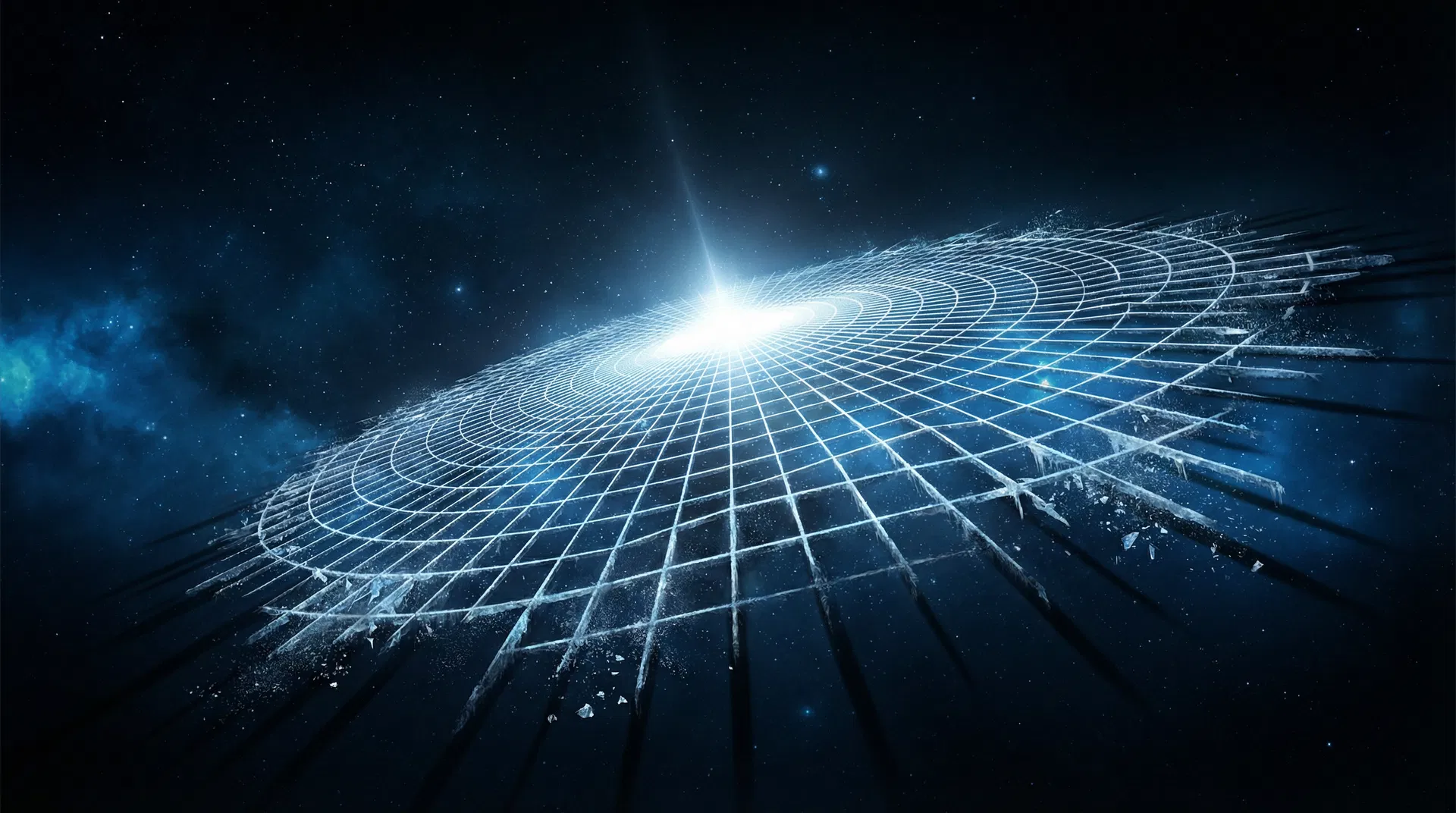
Lambda Cold Dark Matter
The Standard Model of Cosmology
ΛCDM is the prevailing cosmological model, describing a universe that began with a Big Bang and has been expanding ever since, driven by dark energy (Λ) and structured by cold dark matter. It is mathematically precise and empirically well-supported by CMB data, large-scale structure surveys, and Type Ia supernova observations.
Strengths
- +Exceptional predictive power for large-scale structure
- +Confirmed by Planck CMB measurements
- +Accounts for observed accelerating expansion
Limitations
- −Dark energy and dark matter remain unexplained physical entities
- −No account for consciousness or observer-dependent phenomena
- −Heat death endpoint offers no mechanism for cosmic renewal
- −Hubble tension unresolved
C4 Assessment
C4 accepts ΛCDM's geometric and thermodynamic framework as the physical substrate. Where ΛCDM ends — at heat death — C4 begins, proposing that the thermodynamic gradient itself is the computational engine of a self-correcting cycle.
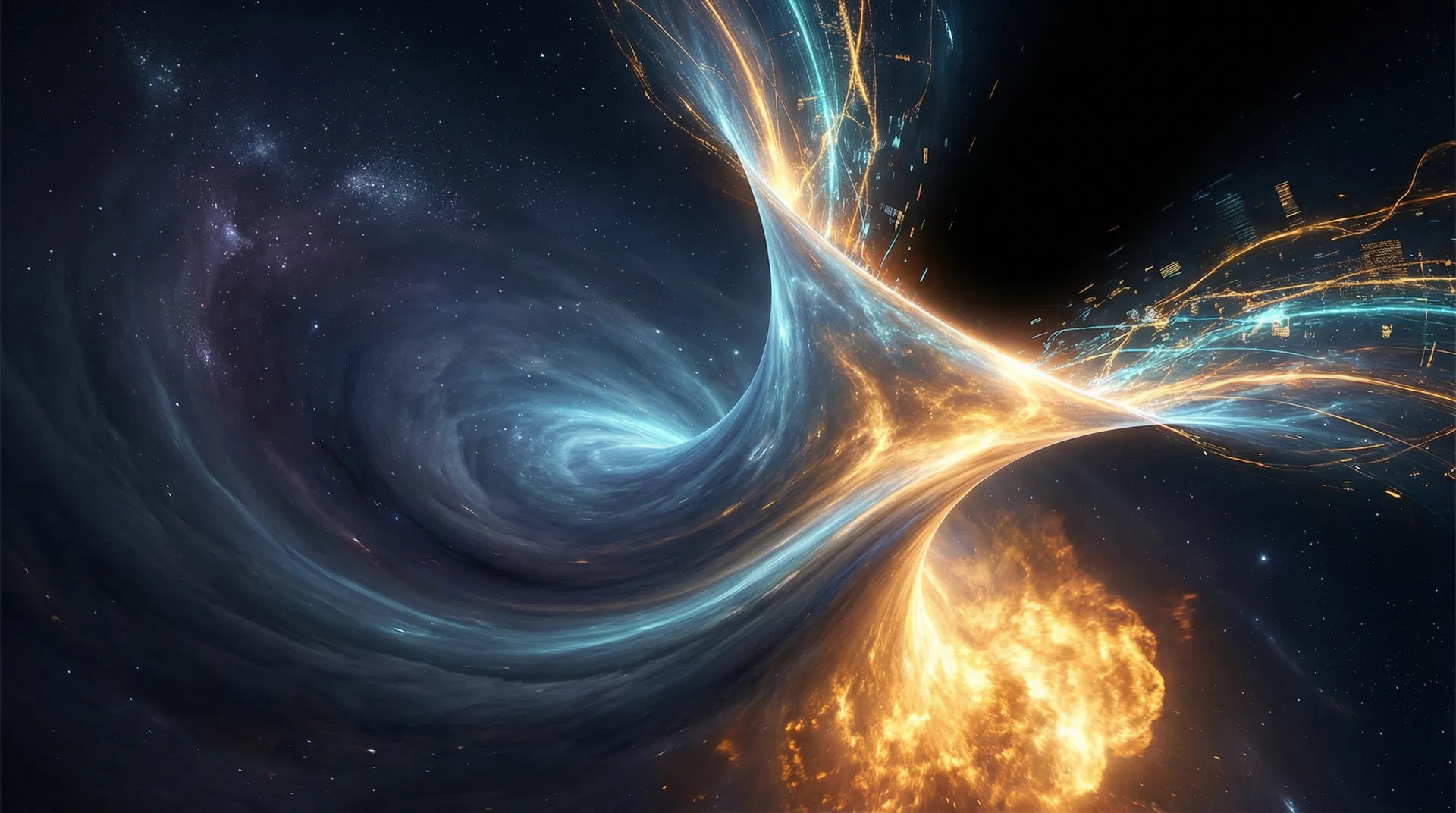
Conformal Cyclic Cosmology
Penrose's Geometric Rebirth
Proposed by Sir Roger Penrose, CCC posits that the universe undergoes infinite cycles (aeons), where the remote future of one aeon — dominated by massless particles — becomes conformally equivalent to the Big Bang of the next. Hawking radiation from black holes is the primary mechanism for information transfer between aeons.
Strengths
- +Mathematically rigorous conformal geometry
- +Resolves the Second Law paradox across cycles
- +Predicts Hawking radiation 'echoes' (Concentric Temperature Rings) in CMB
Limitations
- −Information transfer mechanism is lossy — structural data is not preserved
- −No role for consciousness or biological complexity
- −Observational evidence for CTRs remains contested
C4 Assessment
C4 is a direct extension of CCC. C4 accepts Penrose's conformal boundary geometry but upgrades the information transfer mechanism: rather than passive Hawking radiation, C4 proposes an active ultra-light scalar field (the C4 field) that encodes and transmits thermodynamic complexity — including the conditions for life — across the conformal boundary.

Integrated Information Theory
Consciousness as Intrinsic Cause-Effect Structure
Developed by Giulio Tononi, IIT proposes that consciousness is identical to integrated information (Φ). Any system with high Φ — the degree to which its parts are causally integrated — has subjective experience. IIT is a purely information-theoretic framework, agnostic about substrate, and makes no cosmological claims.
Strengths
- +Rigorous mathematical formalism (Φ measure)
- +Substrate-independent — applies to biological and artificial systems
- +Generates testable predictions about neural correlates of consciousness
Limitations
- −No cosmological scope — cannot explain why the universe exists or cycles
- −Φ computation is NP-hard for large systems
- −Panpsychist implications are philosophically contested
C4 Assessment
C4 treats IIT's Φ as a local measure of the very quantity the C4 field is optimizing globally. In C4, the universe is not merely a backdrop for consciousness — it is a system that maximizes integrated thermodynamic complexity over cosmic time, with IIT describing the local expression of that global process.

Orchestrated Objective Reduction
Quantum Gravity and the Collapse of Consciousness
Proposed by Roger Penrose and Stuart Hameroff, Orch-OR argues that consciousness arises from quantum computations in microtubules within neurons. These computations are 'orchestrated' by biological processes and terminated by objective reduction — a quantum gravity effect at the Planck scale. Consciousness is thus a fundamental feature of spacetime geometry.
Strengths
- +Connects consciousness directly to fundamental physics (quantum gravity)
- +Proposes a specific biological substrate (microtubules)
- +Penrose's OR mechanism is grounded in his broader quantum gravity work
Limitations
- −Quantum coherence in warm, wet biological tissue is extremely fragile
- −No cosmological mechanism — does not explain cosmic cycles
- −Microtubule quantum computation remains experimentally unconfirmed
C4 Assessment
C4 shares Orch-OR's intuition that consciousness and spacetime geometry are related, but operates at a different scale. Where Orch-OR looks inward to the microtubule, C4 looks outward to the conformal boundary of the universe. The C4 field acts as a cosmic-scale analogue of Penrose's OR mechanism — a geometry-level process that encodes complexity across aeons.
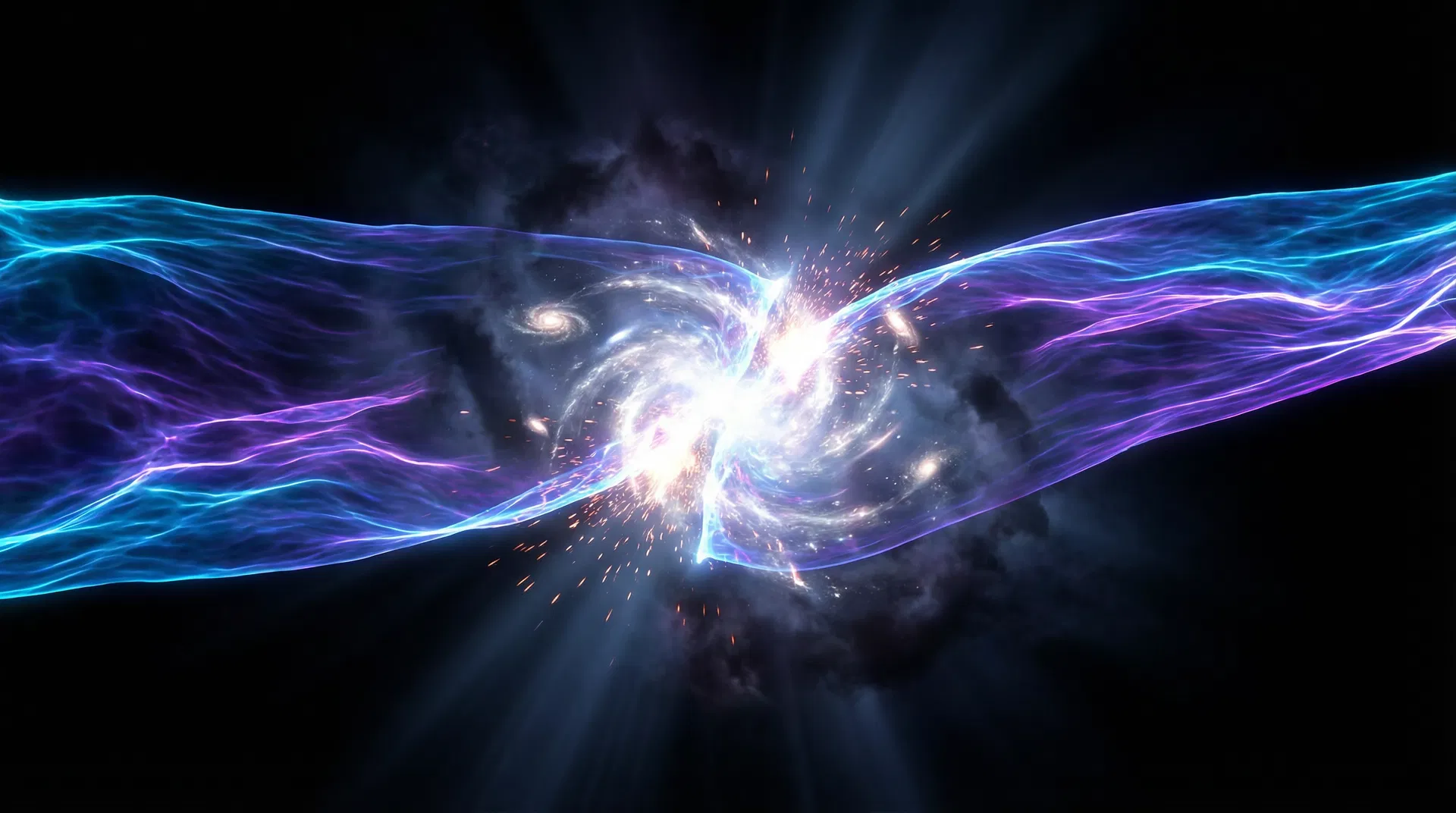
Ekpyrotic / Cyclic Universe
Colliding Branes and the Big Bounce
The Ekpyrotic model, developed by Paul Steinhardt and Neil Turok, proposes that the Big Bang was not a beginning but a collision between two higher-dimensional branes. The universe cycles through expansion and contraction, with each brane collision resetting the thermodynamic clock. Unlike CCC, the Ekpyrotic bounce is violent and destructive — all structural information is erased.
Strengths
- +Avoids the initial singularity problem
- +Generates a scale-invariant spectrum of perturbations without inflation
- +Provides a physical mechanism for cosmic cycles
Limitations
- −Information is completely destroyed at each bounce — no continuity
- −No mechanism for preserving or transmitting complexity across cycles
- −No role for consciousness or observer-dependent phenomena
- −Brane collision dynamics are poorly constrained
C4 Assessment
C4 and Ekpyrotic share the cyclic universe framework, but are fundamentally opposed on information continuity. Ekpyrotic treats each cycle as a clean slate; C4 proposes that thermodynamic complexity — the conditions that gave rise to life — is precisely what is preserved and transmitted. The C4 field is the mechanism Ekpyrotic lacks.

Loop Quantum Cosmology
Quantum Geometry Prevents the Singularity
Loop Quantum Cosmology applies the discrete geometry of Loop Quantum Gravity to the early universe. At the Planck scale, spacetime is quantized into discrete spin networks. This quantum repulsion prevents the Big Bang singularity, replacing it with a 'Big Bounce' — a minimum-volume state from which expansion resumes. LQC is a rigorous quantum gravity approach to cosmology.
Strengths
- +Resolves the initial singularity via quantum geometry
- +Mathematically consistent with Loop Quantum Gravity
- +Predicts a pre-Big Bang contracting phase with observable signatures
Limitations
- −No mechanism for information transfer across the bounce
- −Does not address consciousness or biological complexity
- −Quantum gravity effects are currently unobservable at accessible energy scales
C4 Assessment
C4 is compatible with LQC's quantum bounce mechanism. LQC provides the physical floor — the minimum-volume quantum state — while C4 provides the information-theoretic ceiling: the scalar field that encodes complexity at the conformal boundary before the bounce. Together they could describe a complete cycle from quantum geometry to thermodynamic complexity.
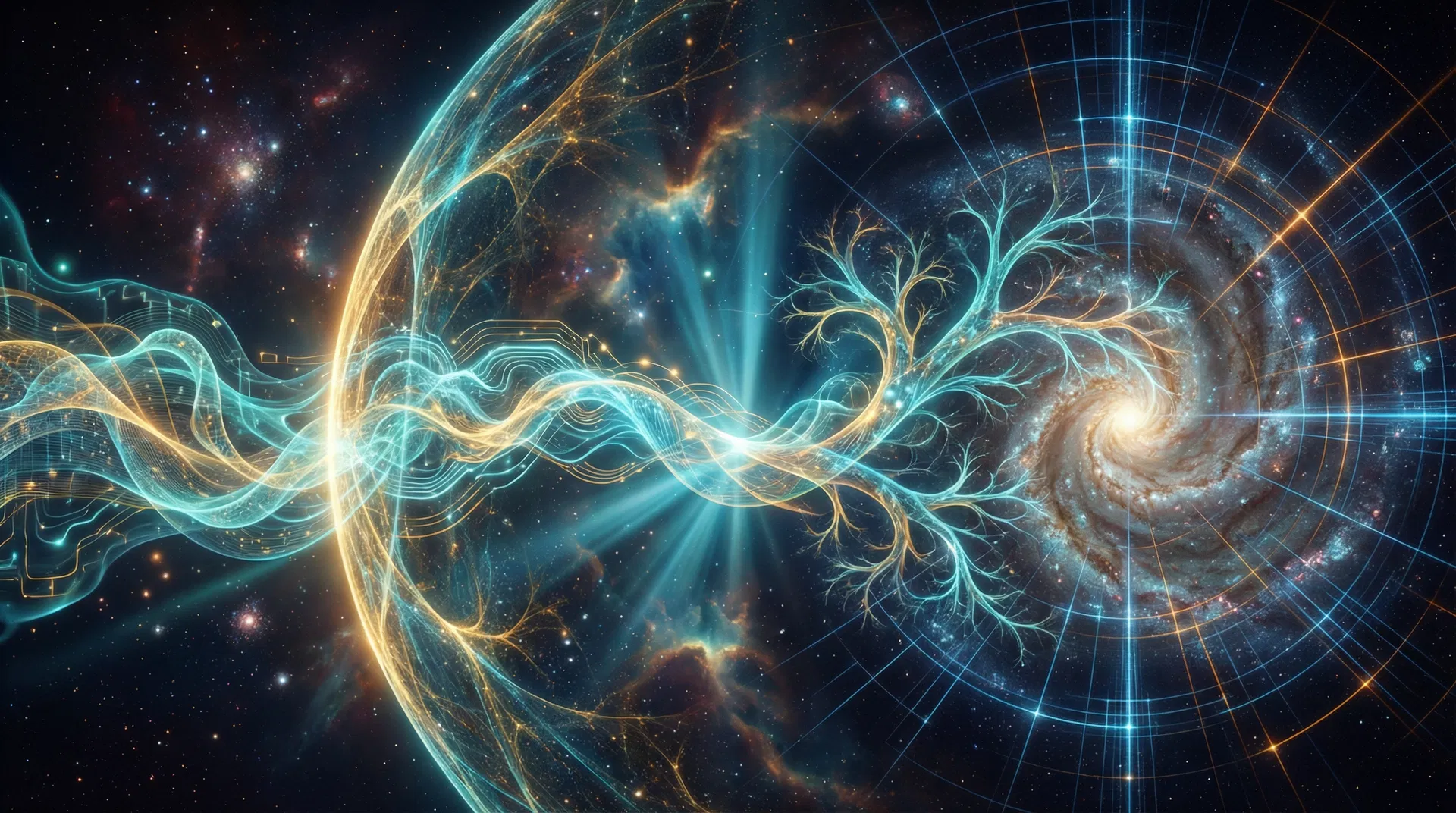
Conscious Cyclic Cosmology
The Grand Synthesis
C4 (Conscious Cyclic Cosmology) extends Penrose's Conformal Cyclic Cosmology by proposing a third physical component alongside dark energy and dark matter: an ultra-light scalar field that encodes thermodynamic complexity — the conditions that gave rise to biological life — and transmits it across the conformal boundary between cosmic aeons. The universe is not a random accident; it is a self-correcting system that preserves and amplifies the conditions for complexity.
Strengths
- +Builds on the mathematically rigorous foundation of CCC
- +Generates falsifiable predictions (3I/ATLAS trajectory, biological resonance signatures)
- +Unifies cosmological cycles with information-theoretic consciousness
- +Accepted in JBIS Vol. 79, March 2026
Limitations
- −Ultra-light scalar field is speculative — not yet directly detected
- −Consciousness-cosmology link requires further theoretical development
- −Predictions are in early observational window (March 2026)
C4 Assessment
C4 is the synthesis: it accepts ΛCDM's geometry, CCC's conformal cycles, IIT's information-theoretic consciousness, and LQC's quantum bounce, while providing the missing mechanism — the scalar field — that connects them all. It is the only framework that treats the emergence of life as a cosmological necessity rather than a statistical accident.